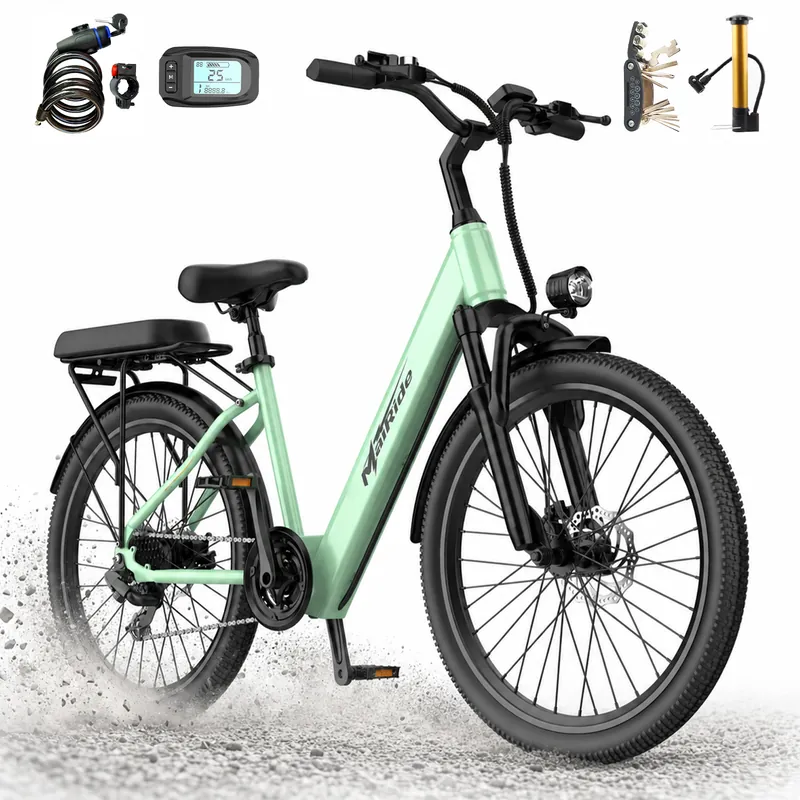
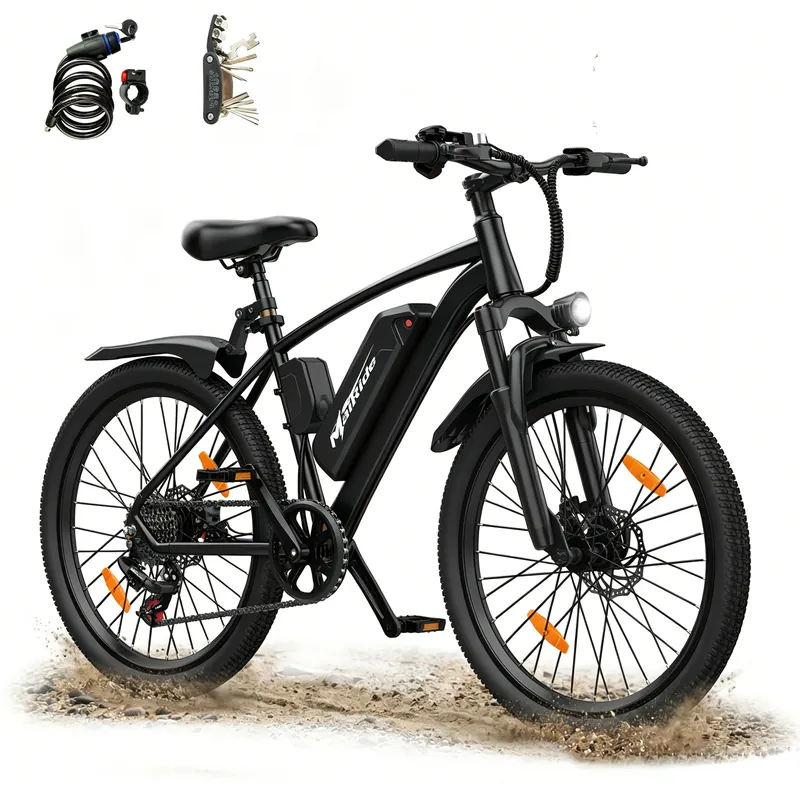
Mairide e-bikes in the UK: Q7 vs SU7 comparison
Mairide is one of the more frequently searched electric bike brands on our catalogue, and with good reason: they offer two sub-£400 models that claim a legal 250W continuous motor, removable lithium batteries and disc brakes.
At around £347 for the SU7 and £371 for the Q7, they sit right in the entry-level commuter bracket. However, the two bikes take very different approaches to geometry, wheel size and battery capacity. This guide breaks down the verified technical specifications of both models to help you choose the right one for your commute.
At a glance: specifications compared
| Specification | Mairide Q7 | Mairide SU7 |
|---|---|---|
| Motor rating | 250W brushless rear hub | 250W brushless rear hub |
| Battery capacity | 36V 10Ah (360 Wh) | 36V 13Ah (468 Wh) |
| Wheel diameter | 26-inch | 24-inch |
| Gearing | 7-speed Shimano derailleur | 7-speed Shimano derailleur |
| Brakes | Front and rear mechanical disc | Front and rear mechanical disc |
| Frame design | High-step commuter frame | Low-step / step-through frame |
| Indicative price | Around £371 | Around £347 |
| Road legality in UK | Road-legal EAPC (250W, 15.5 mph) | Road-legal EAPC (250W, 15.5 mph) |
Battery capacity and real-world range
The biggest functional difference between the two models is the battery pack:
- Mairide Q7: 36V 10Ah yields 360 Wh of stored energy.
- Mairide SU7: 36V 13Ah yields 468 Wh of stored energy — an extra 108 Wh (30% more capacity).
Manufacturer listings often claim "up to 60-80 km" on a single charge. In real British conditions (12 Wh per mile on mixed rolling terrain for an 80 kg rider in tour assist), here is what you can realistically expect:
- Mairide Q7 (360 Wh): Approximately 28 to 33 miles of assisted riding.
- Mairide SU7 (468 Wh): Approximately 36 to 42 miles of assisted riding.
If your daily round-trip commute is 12 to 15 miles, the Q7 will require charging every other day, whereas the SU7 can comfortably cover three days of riding before plugging into the wall. Both batteries are key-locked and removable, meaning you can carry the battery pack inside your home or office to charge without wheeling the entire bicycle indoors.
You can verify your specific rider weight, terrain and weather using our free e-bike range calculator.
Wheel size: 26-inch vs 24-inch
Wheel size decides how these two bikes roll and who can comfortably ride them:
The Mairide Q7 uses standard 26-inch wheels. This is the classic adult hybrid size. A 26-inch wheel rolls over potholes and tarmac imperfections with greater stability and less vibration. Replacement tyres and inner tubes in 26-inch are available at every bike shop in the UK. The standover height is suited to riders between 5'4" and 6'0" (163 to 183 cm).
The Mairide SU7 uses 24-inch wheels on a step-through frame. Smaller 24-inch wheels lower the centre of gravity and make the bike significantly easier to mount and dismount, especially when wearing work trousers or when stopping frequently in urban traffic. It is an ideal setup for smaller riders (5'0" to 5'7", or 152 to 170 cm) or anyone who feels intimidated balancing a tall 26-inch e-bike at red lights.
Gearing and hill climbing
Both models feature a 7-speed Shimano Tourney rear derailleur with a thumb shifter on the right handlebar.
Because both bikes use rear hub motors rather than mid-drives, the motor pushes the rear wheel directly and does not multiply its torque through the gears. On flat roads and gentle inclines (up to 5-6%), both bikes cruise smoothly at the legal 15.5 mph assist limit. On steep hills (above 8%), you will need to downshift to gear 1 and contribute moderate pedalling effort to maintain momentum.
For an explanation of how hub motors behave on gradients, see our hub motor vs mid-drive explainer.
British weather and winter commuting readiness
Both the Q7 and SU7 arrive with basic mudguards and an integrated front LED light powered directly from the 36V main battery:
- Mudguards: Full-length metal mudguards keep road spray, winter salt and surface grit off your work trousers and out of the bottom bracket bearings. If you ride year-round in the UK, full-coverage fenders are essential rather than optional.
- Lighting: The front light turns on via the handlebar display panel, so you never have to remember to recharge a separate USB headlight. For dark winter commutes on unlit suburban roads, we advise supplementing the built-in lamp with an auxiliary high-lumen handlebar light.
- Replacement batteries: Both models use standard silver-fish or Hailong-style casing lithium packs with standard 3-pin or DC charge ports. Replacement battery packs are straightforward to source in the UK for £150 to £200, which keeps long-term ownership costs predictable over a 3 to 5-year operating window.
UK road legality check
Both the Q7 and SU7 arrive configured to UK and EU EAPC standards:
- 250W continuous rated motor.
- Assistance automatically cuts out at 15.5 mph (25 km/h).
- Pedal-assist sensor (PAS) engages power as you rotate the pedals.
Under UK legislation, riders must be at least 14 years old. No driving licence, DVLA registration, number plate, vehicle tax or compulsory insurance is required to ride them on public roads or designated cycleways. You can confirm all compliance requirements via our UK e-bike legality checker.
Verdict: which one should you choose?
Choose the Mairide SU7 if:
- You want the best battery capacity per pound (£347 for 468 Wh is exceptional value).
- You prefer an easy step-through frame that requires no swinging a leg over a high top tube.
- Your height is between 5'0" and 5'7".
Choose the Mairide Q7 if:
- You are 5'5" or taller and prefer a traditional hybrid frame geometry.
- Your route includes longer stretches of rough tarmac or gravel paths where 26-inch wheels offer smoother rolling.
- You want maximum tyre and tube compatibility across high street bicycle shops.