Best electric bikes under £1,000 in the UK
Under £1,000 is where most UK buyers start, and it is a more interesting price point than it looks. You can get a genuinely usable commuter bike, or you can get something that will disappoint you within a month. The difference is almost never the price. It is which specifications the money went into.
This guide is based on what we can see in the listings of the 159 e-bikes in our catalogue that come in under £1,000, with a declared motor and no toy or tricycle in sight. We have not ridden them all; what we have done is read the specifications and work out what they mean.
What £500-1,000 realistically buys
At the bottom of the range, around £300-500, you get:
- A 250W hub motor in the rear wheel, which is the simplest and cheapest arrangement.
- A 36V battery of 10 to 13 Ah, which is roughly 360-470 Wh.
- Mechanical disc brakes, sometimes only on one wheel.
- A steel or basic aluminium frame.
- 7-speed gearing, usually a basic Shimano Tourney-level groupset.
- A weight of 20-25 kg, which is heavy but normal at this price.
That is enough for a 5-10 mile commute on flat or gently rolling ground, and it is a legitimate purchase. What you are not getting is refinement: the motor cuts in and out abruptly, the brakes need regular adjustment, and the battery will lose capacity faster than a premium one.
Between £700 and £1,000 you start to see:
- Larger batteries (13-15 Ah, 470-540 Wh), which is the single biggest improvement to range.
- Hydraulic disc brakes on a few models.
- Better frames with proper cable routing and a more comfortable geometry.
- Torque sensors instead of cadence sensors on some models, which makes the assistance feel natural rather than like a switch.
That last point is worth more than it sounds. A cadence sensor detects that the pedals are turning and applies a set amount of power. A torque sensor measures how hard you are pushing and responds proportionally. On a cadence-sensor bike, the motor feels like it is either on or off. On a torque-sensor bike, it feels like you have stronger legs. If you can find a torque sensor under £1,000, that is the specification to prioritise.
What the numbers in the listing actually mean
Motor: 250W is the legal number
In the UK, an electric bike that is legal to ride on the road must have a motor rated at 250W continuous, with assistance cutting out at 15.5 mph (25 km/h). Anything above that is a motor vehicle in law, regardless of what the listing calls it.
That means the 500W and 1000W bikes in this price bracket are not road-legal. They are sold for private land. If your plan is to commute, ignore them, however tempting the specification looks.
Among the bikes we list under £1,000 with a declared motor, 250W is by far the most common rating, which reflects the fact that the market has largely settled on the legal limit for European and UK sales.
Battery: look at watt-hours, not just volts
Sellers love to quote voltage because 48V sounds better than 36V. What actually determines range is watt-hours, which is volts × amp-hours.
- 36V × 10Ah = 360 Wh
- 36V × 13Ah = 468 Wh
- 48V × 10Ah = 480 Wh
A 48V 10Ah battery and a 36V 13Ah battery hold almost the same energy. The 48V system will deliver more power to a given motor, but it will not go further on the same charge.
As a rough guide for a 250W bike with a rider of average weight on mixed terrain: allow 10-12 Wh per mile. A 400 Wh battery is therefore good for around 33-40 miles of assisted riding, less in hilly country or with heavy loads, more if you use the lower assistance levels.
Be sceptical of range claims in listings. "Up to 80 km" usually means the lowest assistance level, a light rider, flat ground and a following wind.
Brakes: the specification people ignore
At 20-25 kg plus a rider, an e-bike needs more braking than a bicycle of the same price. Mechanical disc brakes are acceptable. Hydraulic disc brakes are markedly better: more power, less lever effort, and they self-adjust as the pads wear.
If a bike at £900 has hydraulic brakes and one at £850 has mechanical, the extra £50 is worth it. Brakes are not the place to save money.
Weight: it matters more than on a normal bike
An e-bike is heavy before you add anything. At this price point, 22-25 kg is normal. That matters for three reasons: carrying it upstairs, lifting it onto a rack, and what happens when the battery runs out.
If you live in a flat and need to carry the bike up a flight of stairs, weight should be near the top of your list, and a folding model at 17-19 kg may serve you better than a full-size bike at 24 kg.
The models we would shortlist
These are the ones where the specification adds up at the price. Prices are indicative and move; check the current figure on each page.
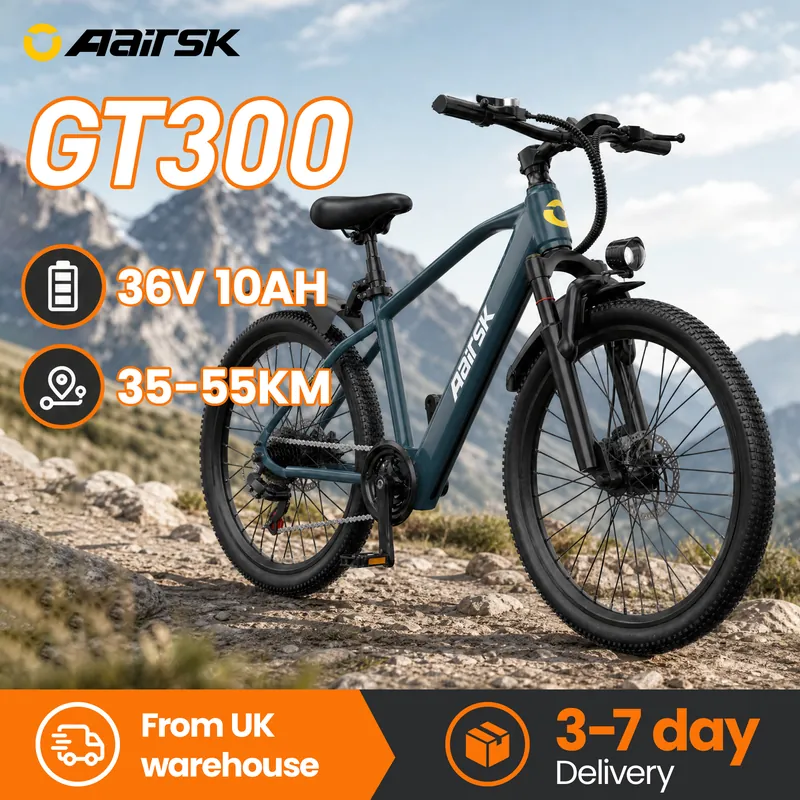
Aairsk GT300 — 250W, 36V 10Ah, 26-inch wheels, 7-speed. Around £326.
A conventional city e-bike with the specification you actually need for a commute: legal motor, a battery big enough for 25-30 miles of assisted riding, and standard 26-inch wheels that make tyres and tubes cheap and easy to find. The 7-speed gearing is basic but adequate. This is the one we would point a first-time buyer at.
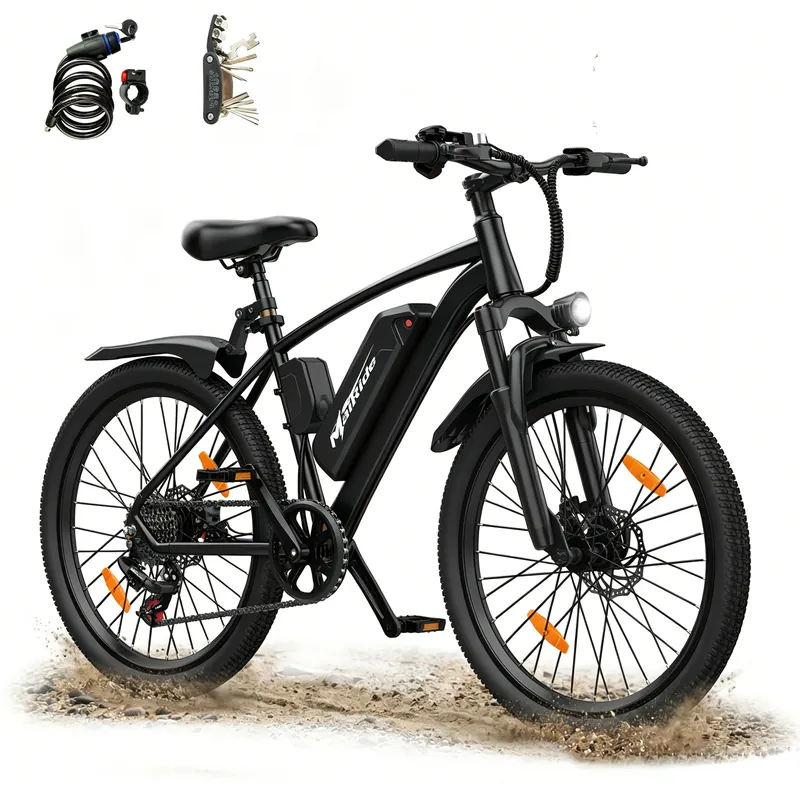
Mairide Q7 — 250W, 36V 10Ah, 26-inch wheels. Around £371.
Very similar specification to the GT300, with a slightly different frame and finish. Worth comparing the two on geometry and on which one fits you better, because at this level the differences are in the details rather than the hardware.
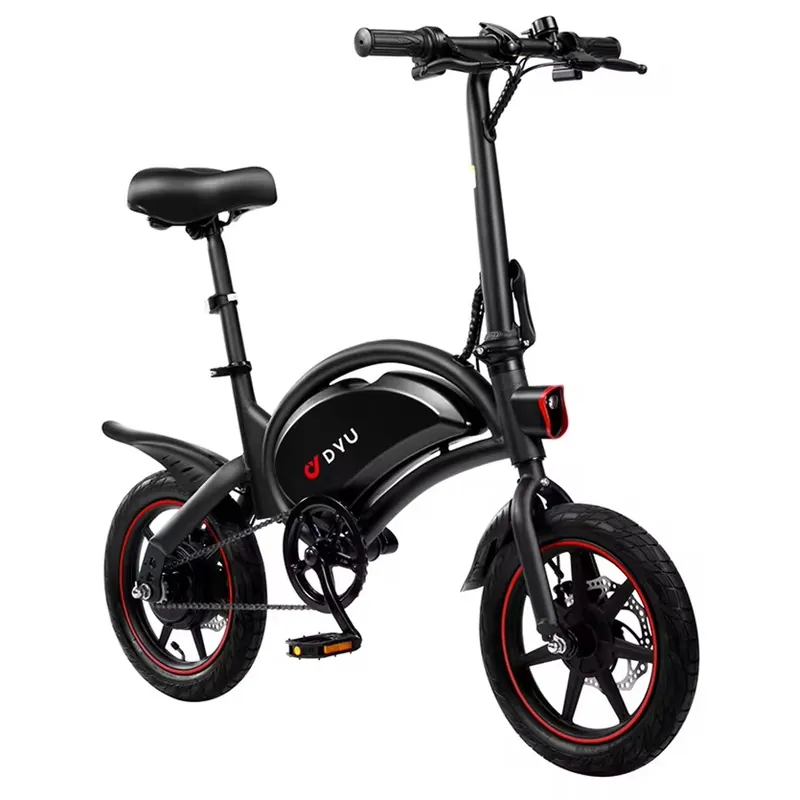
DYU D3F — 250W, 36V 10.4Ah, 14-inch wheels. Around £369.
A small-wheel folder. The trade-off is obvious: 14-inch wheels are nervous on rough surfaces and potholes, and the ride is firmer. In exchange you get something that folds small enough for a train, a lift or a cupboard, at a weight you can carry with one hand. For a multimodal commute, that trade is often worth it.
What we would avoid at this price
Anything over 250W if you need it for the road. It is not legal, it is not insurable, and no discount makes that a good trade.
Bikes with no stated battery capacity. If the listing says "high capacity lithium battery" and nothing else, you cannot compare it, and the seller is hiding something.
Very cheap full-suspension e-bikes. A suspension fork and rear shock at this price are heavy, undamped and need servicing. A rigid bike at the same money is lighter and rides better on tarmac.
Anything with a 12-month battery warranty and no stated capacity threshold. Battery replacement is the largest running cost of an e-bike, and the warranty is what protects you.
The honest summary
Under £1,000 you can buy a legal, usable commuter e-bike with a 250W motor, a 400-470 Wh battery and mechanical disc brakes. It will weigh 22-25 kg, it will not feel refined, and it will do the job.
The specification that matters most, in order: legal 250W motor, battery capacity in watt-hours, hydraulic brakes if you can get them, and weight if you have to carry it.
Everything else is detail.